
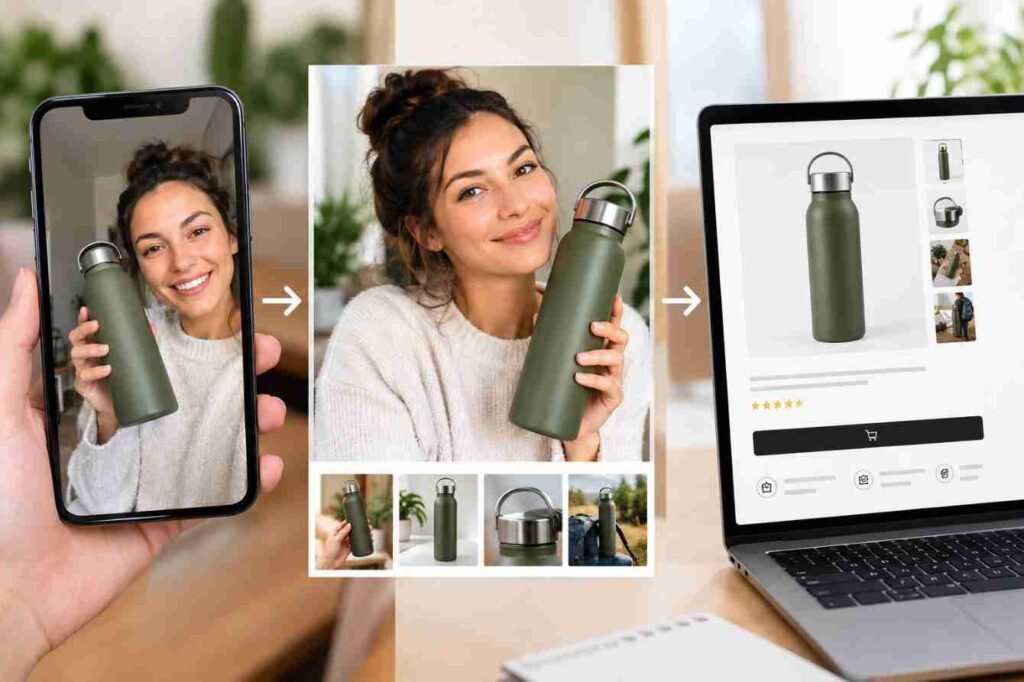
Customer content can be more persuasive than a beautifully staged product shoot precisely because it does not look like advertising. But that advantage disappears when brands simply collect reviews, unboxings, and TikTok clips and scatter them across a website.
Learning how to turn UGC into converting e-commerce content means treating those customer assets as evidence inside the buying journey. The best UGC answers a shopper’s unanswered question, demonstrates the product in context, reduces uncertainty, and gives the customer a logical next step.
That matters because shoppers actively seek validation. Pew Research found that 82% of U.S. adults at least sometimes consulted online ratings or reviews before buying something for the first time, while 55% had watched online product-review videos.
UGC Works Best When It Solves Purchase Anxiety

A five-star comment saying “Love it!” is technically social proof, but it tells a hesitant customer almost nothing.
High-converting UGC tends to answer specific questions: Does the jacket fit someone with broad shoulders? Can the blender handle frozen fruit? Is the desk difficult to assemble? Does the moisturizer feel greasy? What does the color look like outside studio lighting? This is why specificity matters more than praise.
It has been demonstrated the importance of authenticity in reviews. In one study examining deceptive hotel reviews, human judges performed little better than chance at identifying fake reviews, illustrating why shoppers cannot reliably evaluate authenticity simply by reading polished testimonials.
Brands therefore need systems for collecting genuine, detailed customer experiences rather than manufacturing content that merely imitates them.
Turn Raw UGC Into a Conversion Narrative
The strongest customer video normally has a simple progression. Rather than posting every clip exactly as received, edit the useful moments into a story while preserving the customer’s natural delivery.
Win the First Three Seconds
Start with the moment that creates curiosity.
A skincare video might open with the customer’s before image. A storage product could begin with an overflowing cabinet. A shoe video might immediately show someone bending the sole or walking after an eight-hour shift.
Avoid slow introductions such as “Hi guys, I recently received this product.” The viewer needs the reason to keep watching before the background story.
Move From Problem to Proof
After the hook, establish the problem quickly, introduce the product, and show evidence.
Think:
Problem → Product → Demonstration → Result → Action
A creator discussing a vacuum, for example, should not spend 25 seconds listing specifications. Showing pet hair on a rug, demonstrating one pass of the vacuum, and revealing the cleaned surface communicates far more.
That same principle should influence your written merchandising. Strong customer language can identify concerns that your team should address in product descriptions that convert for U.S. shoppers.
Keep the Customer Look Without Keeping Every Flaw
Authenticity does not mean refusing to edit. Remove dead air, tighten repetitive sections, improve sound when necessary, add accurate captions, and crop footage for the intended platform. For TikTok, Instagram Reels, and similar mobile placements, vertical 9:16 video will usually make better use of screen space.
But resist turning genuine customer footage into something that suddenly looks like a television commercial. Natural rooms, normal voices, imperfect demonstrations, and recognizable everyday situations are part of the credibility signal.
Cornell research into online marketplaces also found that shoppers trusted seller-created, high-quality product photos more than stock photography or poor-quality images. The lesson is useful for UGC teams: authentic does not have to mean visually careless.
Put UGC Where Purchase Decisions Actually Happen
Social media should not be the final destination for your best customer content.
Move proven assets deeper into the commerce experience.
| Buying Stage | Best UGC Format | Main Job |
| Discovery | Short customer videos | Capture attention |
| Consideration | Demonstrations and comparisons | Explain usefulness |
| Product page | Reviews, photos, sizing and usage clips | Reduce uncertainty |
| Cart/checkout | Compact ratings or reassurance | Reinforce confidence |
| Retargeting | Testimonials and objection-focused ads | Recover hesitant shoppers |
Product pages are especially important because this is where customers compare expectations with risk.
Customer images can show scale, fit, texture, color, installation, packaging, and real-life environments that studio photography cannot completely reproduce.
The American Marketing Association has highlighted research showing that characteristics of user-generated reviews can influence perceived credibility and purchase intention, reinforcing that the context surrounding UGC can matter as much as the message itself.
Build a UGC Conversion Test Instead of Guessing

A useful testing framework separates the creative into four variables.
First, test the hook. Keep the product demonstration identical but compare an unexpected statement, customer problem, question, before-and-after opening, and result-first opening.
Second, test the creator. Different customers produce different levels of relatability even when they communicate the same benefit.
Third, test the proof. Compare spoken testimonials, demonstrations, review screenshots, before-and-after evidence, and customer photographs.
Finally, test the call to action. “Shop now” may work for high-intent audiences, while “See how it works” or “Find your size” can suit shoppers who still need information.
Track click-through rate, conversion rate, cost per acquisition, revenue per visitor, and return on ad spend for commercial performance.
Beyond measuring individual creative metrics, it is important to understand whether content is meeting the needs of its intended audience.
Learning how to measure content performance by search intent helps marketers evaluate whether content aligns with what users are looking for and identify opportunities to improve engagement, relevance, and conversions.
For video, watch-time and early-view retention can help diagnose whether the opening is failing before shoppers ever reach the offer.
The important point is to change one major variable at a time. Otherwise, you may know which advertisement won without knowing why.
Turn Winning UGC Into a Repeatable Content System
Once a customer asset performs well, do not simply increase the advertising budget.
Study the reason.
Was the hook unusually strong? Did the customer handle a common objection? Was the demonstration clearer? Did viewers identify with the creator?
Turn that finding into a reusable brief for future creators.
One strong 30-second video might become a paid-social ad, product-page demonstration, email GIF, still-image testimonial, organic Reel, FAQ answer, landing-page proof block, and retargeting creative.
Brands can extend the value of their content by connecting product recommendations with relevant affiliate offers and online shopping opportunities.
Exploring how to monetize blog content with affiliate e-commerce tactics can help publishers identify ways to turn useful content into revenue while keeping product suggestions relevant to readers and their purchase decisions.
A defined stack of editing, analytics, review-management, and publishing software can make that process easier; these content marketing tools recommended by U.S. marketers are a useful starting point when building the workflow.
Do Not Optimize Authenticity Out of the Content
Understanding how to turn UGC into converting e-commerce content also means knowing what not to change.
Do not rewrite a customer’s opinion until it communicates something they never meant. Do not hide legitimate criticism simply because it makes the product look less perfect. And do not turn an unusually successful result into an implied promise for every buyer.
The Federal Trade Commission says endorsements must be truthful and not misleading, and material relationships between brands and endorsers generally need appropriate disclosure. Its Consumer Reviews and Testimonials Rule, effective since October 21, 2024, also addresses fake and deceptive reviews.
The FTC’s review-platform guidance further recommends maintaining processes designed to ensure reviews accurately reflect feedback from genuine customers.
BBB similarly warns consumers that fake reviews remain difficult to eliminate completely, which makes verified interactions, specific details, and transparent review practices valuable trust signals.
Frequently Asked Questions
1. What type of UGC converts best for e-commerce?
Product demonstrations, before-and-after content, customer photos, objection-focused testimonials, unboxings, and specific reviews generally provide the most useful purchase evidence.
2. Where should e-commerce brands place UGC?
Use it on product pages, landing pages, social ads, organic social posts, email campaigns, retargeting ads, and selected cart-stage reassurance areas.
3. Should brands edit customer-created videos?
Yes. Brands can trim footage, add captions, improve pacing, and resize videos while preserving the customer’s genuine opinion and avoiding misleading alterations.
4. How do you know whether UGC is increasing conversions?
Compare conversion rate, CTR, CPA, revenue per visitor, and ROAS against existing creative. Video retention metrics can reveal why certain assets succeed or fail.
The Takeaway
UGC becomes powerful commerce content when it stops being decoration and starts functioning as evidence.
The practical goal is not to collect the largest library of smiling customers. It is to find authentic customer moments that resolve real buying questions, place those moments near decisions, measure their commercial impact, and reproduce the patterns that work.
That is ultimately how to turn UGC into converting e-commerce content without destroying the quality that made customer content persuasive in the first place. Keep the voice human, make the proof specific, shorten the route from evidence to purchase, and let real customer experience carry the argument.