

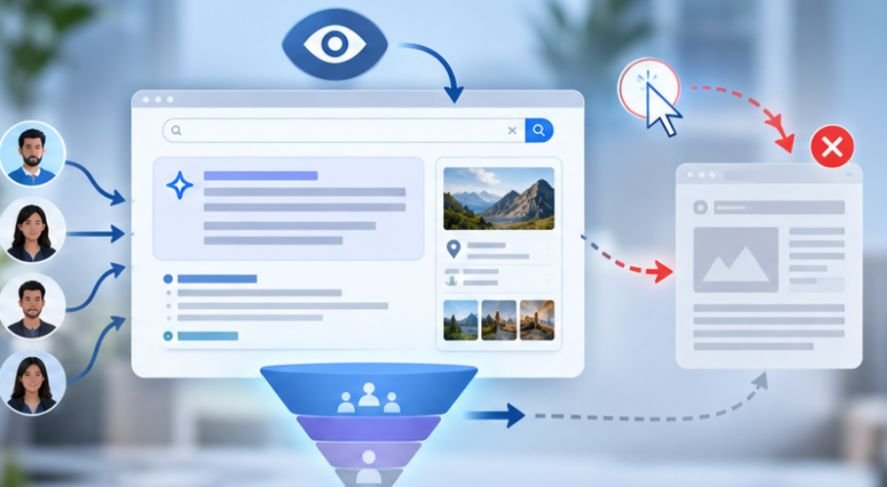
More than two-thirds of U.S. Google searches now end without a click to any website. Similarweb clickstream data analyzed for January through April 2026 put the figure at 68.01%, up from about 60% in 2024.
That changes the economics of search marketing. A strong zero click search strategy for content marketing can no longer judge success only by sessions and organic click-through rate. Content also has to earn visibility inside AI Overviews, featured answers, knowledge-style results, social feeds, and generative platforms where the audience may never reach the publisher’s site.
The goal is not to surrender the click. It is to make your brand valuable before the click happens—and compelling enough that people remember it afterward.
Why Zero-Click Search Deserves Its Own Content Strategy
The clearest evidence comes from actual browsing behavior. Pew Research Center analyzed 68,879 Google searches made by U.S. adults. When an AI summary appeared, users clicked a traditional search result during only 8% of visits. Without an AI summary, that figure was 15%. Links cited directly inside AI summaries attracted clicks in only about 1% of visits.
Pew also found that AI summaries were especially common for longer, question-oriented searches. About 60% of searches beginning with question words such as “what,” “why,” “when,” or “who” produced an AI summary in its study.
That means many informational articles are competing not just against ten blue links but against an answer assembled before users ever reach those links. For content marketers, the practical response is Answer Engine Optimization, generative search optimization and traditional SEO working together.
Stop Treating Every Keyword as a Traffic Keyword
The first adjustment is strategic rather than technical. Some searches naturally require a website visit. A person comparing software pricing, downloading a template, checking inventory or requesting a quote still needs deeper information.
Other searches can be resolved directly on the results page: definitions, dates, simple instructions, basic comparisons and factual questions.
Before assigning a content idea, estimate both its ranking opportunity and its click opportunity.
Prioritizing topics by search demand alone can lead to content that attracts impressions but delivers limited business value. Learning how to prioritize content ideas for SEO helps marketers evaluate search intent, ranking potential, topical relevance, and commercial value before deciding which topics deserve investment.
It also improves editorial prioritization. A strong topic clustering strategy for SEO can combine highly answerable informational pages with deeper commercial resources that give readers a reason to continue exploring.
Write Passages That Search Engines Can Actually Extract

A page can be authoritative and still be difficult for machines to interpret. For question-based sections, place a short direct answer immediately below the heading. Roughly 40 to 60 words is usually enough to define the concept, explain the distinction or summarize the process before expanding on it.
Use descriptive H2s and H3s. Keep definitions self-contained. Make lists genuinely sequential. Label comparison criteria clearly.
Federal web guidance makes a similar case for structured publishing. Digital.gov recommends clear headings, semantic HTML, metadata and searchable page structures because they improve discoverability and help systems understand content. The important distinction is that “snippet-friendly” does not mean shallow.
Give the search engine the short answer, then give the human reader what the result page cannot: examples, exceptions, calculations, screenshots, original analysis, templates and decision criteria.
Make Structured Content Machine-Readable
Structured data can reduce ambiguity about what a page contains. Schema.org defines vocabularies for entities and page types such as FAQPage, Organization, Product and other structured information.
JSON-LD, one of the common ways to publish that structured data, is a formal World Wide Web Consortium standard for expressing linked, machine-readable information.
Structured data should support the visible page rather than act as a shortcut to rankings. It does not guarantee an AI citation, rich result or featured snippet.
Treat it as semantic infrastructure: accurate organization information, authorship, products, breadcrumbs and other entities should agree with what users can actually see.
Build Sources Worth Citing, Not Just Pages Worth Ranking
Generative systems work differently from conventional rankings. They retrieve, synthesize and cite information from multiple sources, sometimes with substantial variation between prompts and repeated runs.
A 2026 review of 45 studies on generative engine optimization found that relevance and context position were among the most repeatable factors, while many widely promoted optimization tricks did not consistently transfer across systems. It also warned that improving the likelihood of citation is not the same as proving long-term organic discoverability or business impact. That is an important warning for marketers.
Do not rewrite every paragraph merely to sound quotable. Invest in information that deserves to be referenced: proprietary data, first-hand testing, named methodology, expert commentary, original examples and clearly sourced statistics.
Entity authority also develops outside your own domain. Digital PR, legitimate mentions by respected publications, expert profiles, consistent organization information and participation in relevant communities can reinforce how a brand is understood across the web.
Use a Five-Step Zero-Click Content Test
Before publishing, run each important page through this process.
First, identify the exact question the searcher wants answered. If you cannot express it in one sentence, the page may be targeting too many intents.
Second, write a stand-alone answer near the top. Someone reading only that paragraph should understand the basic answer without additional context.
Third, add information the SERP cannot easily replace. Examples include calculators, proprietary benchmarks, original screenshots, implementation steps, expert judgment or downloadable assets.
Fourth, make entities explicit. Use accurate names for products, organizations, people, concepts and locations rather than relying constantly on vague pronouns.
Fifth, create the next logical action. A useful answer can lead naturally to a deeper tutorial, comparison, template, product, newsletter or related cluster. Editorial teams can map those continuations in advance with content planning templates for small business blogs.
Publish Value Natively Beyond Google
Zero-click behavior is not limited to search engines. LinkedIn posts, YouTube explanations, short-form videos, social threads and AI-generated answers can all satisfy part of a user’s information need without sending an outbound visit.
Instead of posting a teaser that says “click to learn more,” publish something useful on the platform itself. Give away the core idea, framework or finding, while reserving greater depth for the destination page.
This feels counterintuitive if traffic is the only KPI. It makes more sense when brand familiarity and future demand are included.
Replace the Traffic-Only Dashboard

A mature zero click search strategy for content marketing should measure exposure and downstream behavior alongside visits.
Track impressions for priority queries, ownership of featured SERP elements, branded search growth, direct traffic, assisted conversions and qualified leads. Where tooling permits, monitor whether your brand is cited or mentioned in major AI answer systems.
Google Search Console remains useful for impressions, queries and clicks, but marketers should resist interpreting a declining CTR in isolation. If impressions, branded searches and conversions are rising, the content may still be creating demand.
Measure by query class as well. A template page should produce visits. A definition page may deliver most of its value through visibility and brand association.
What Zero-Click Optimization Cannot Fix
Zero-click tactics will not rescue thin content, weak products or an unknown brand simply because a page contains FAQ markup.
They also should not replace technical SEO. Digital.gov’s advanced SEO guidance still emphasizes fundamentals such as crawlability, XML sitemaps, canonical signals and semantic page structure. Digital.gov advanced SEO guidance.
Nor should every topic be optimized for a 50-word answer. Complex legal, financial, medical, technical and purchasing decisions often demand nuance that an extracted passage cannot provide safely or accurately.
The winning approach is not “give Google everything.” It is “give search systems enough clarity to understand your expertise while giving people enough additional value to seek you out.”
Frequently Asked Questions
1. What is a zero-click search?
A zero-click search ends without the user visiting an external website because the result page, featured feature or AI-generated answer already provides enough information.
2. Does zero-click search make SEO less valuable?
No. SEO still creates discovery, authority and demand, but marketers must measure visibility, brand recall and assisted conversions alongside organic visits.
3. What content performs best in AI and featured answers?
Clear definitions, question-based sections, concise summaries, structured comparisons, authoritative evidence and original information are generally easier for retrieval and answer systems to interpret.
4. Should every page use FAQ schema?
No. Structured data should accurately reflect visible content and supported page types. Adding markup does not guarantee richer search presentation or better rankings.
Earn the Answer Before You Earn the Visit
Search has not stopped creating business value simply because fewer searches create immediate visits.
The opportunity has moved earlier in the journey. Brands that answer questions clearly, publish defensible original information, strengthen their entities and build useful content beyond their own domains can influence customers before analytics records a session.
That is the real purpose of a zero click search strategy for content marketing: not chasing impressions for their own sake, but making your company one of the sources people—and machines—recognize when an answer matters. In a search environment where the click is increasingly optional, being remembered is becoming part of ranking.