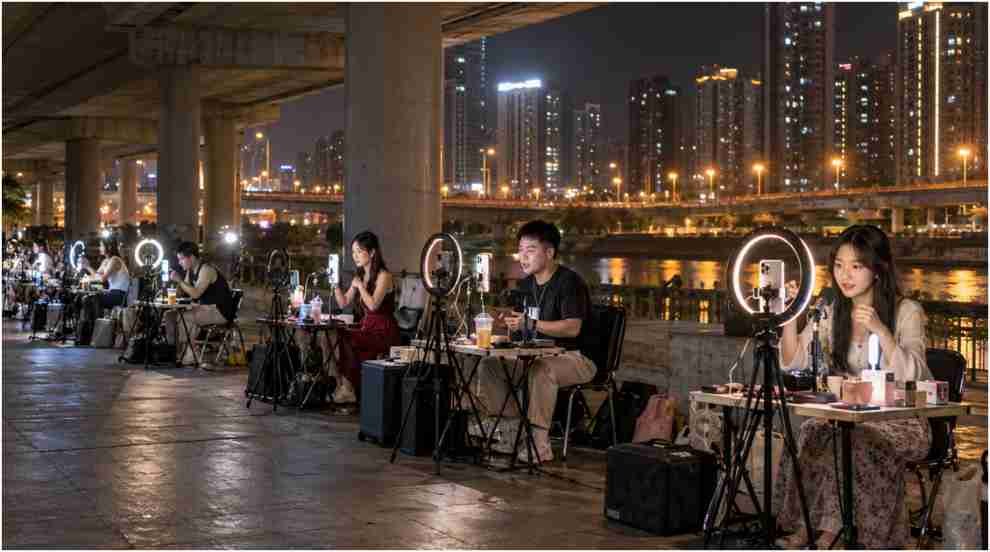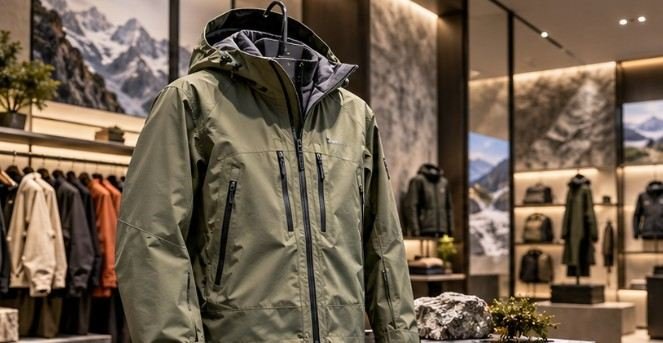
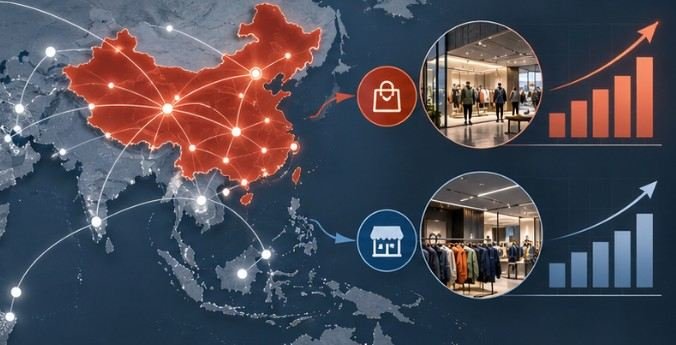
One number makes the question hard to ignore: by the end of 2025, Arc’teryx operated 79 owned stores in Greater China, compared with 73 in North America. That does not prove that is outdoor brand arcteryx pivoting to a china first strategy should be answered with an unconditional yes, but it shows how dramatically the Canadian-born mountaineering label’s center of gravity has changed.
China is no longer merely an overseas expansion market for Arc’teryx. It has become one of the brand’s two most important growth platforms, alongside North America.
The distinction matters. What Arc’teryx appears to be building is less a China-only strategy than a China-powered global luxury-outdoor model.
The China Shift Started With Amer Sports
Arc’teryx was founded in North Vancouver in 1989 and built its reputation around serious climbing equipment, technical shells and unforgiving alpine conditions.
Its corporate environment changed significantly after a consortium led by Chinese sportswear company Anta Sports acquired Amer Sports, Arc’teryx’s parent company, in 2019.
Today, Amer Sports describes Arc’teryx as particularly strong in both North America and Greater China. Its latest annual filing says future geographic growth for the brand will be grounded in those two markets, while Europe and the rest of Asia provide additional expansion opportunities.
That wording is important. The company itself is not publicly describing Arc’teryx as a China-first brand.
Yet the investment pattern tells us China has moved remarkably close to the center of the strategy.
According to Amer Sports’ filings with the U.S. Securities and Exchange Commission, Arc’teryx had 79 company-operated stores across Greater China at the end of 2025, up from 64 at the end of 2023. North America had 73 stores at the end of 2025.
That is an extraordinary retail commitment for a brand whose roots remain firmly Canadian.
China Is Becoming Too Large to Treat as a Side Market
Amer Sports generated $6.57 billion in revenue during 2025. Greater China contributed approximately $1.86 billion across the company’s portfolio, rising 43.4% from $1.30 billion a year earlier. The Americas remained larger at roughly $2.13 billion, but increased only 14.3%.
Those numbers cover all Amer Sports brands rather than Arc’teryx alone, so they should not be mistaken for Arc’teryx-specific market share.
Still, Arc’teryx sits inside Amer’s Technical Apparel division, which reached $2.86 billion in 2025, up 30% from 2024. Amer specifically identified Arc’teryx as its flagship franchise and one of its strongest growth engines.
China’s broader outdoor boom helps explain the opportunity. Chinese government planning reported more than 400 million outdoor-sports participants by the end of 2021 and has continued investing in trails, skiing, climbing and outdoor destinations.
The government’s newer objective calls for around 100 high-quality outdoor-sports destinations by 2030.
That expanding recreation ecosystem creates a much larger customer base for premium technical clothing than China offered a decade ago.
Arc’teryx Is Selling More Than Mountain Equipment
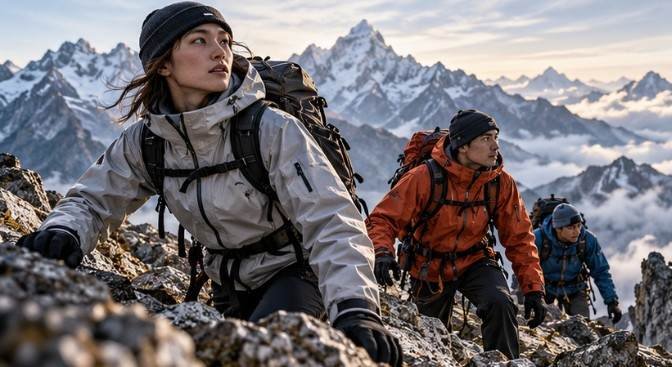
The most interesting part of the Chinese strategy is not simply store count. It is positioning.
In North America, Arc’teryx still speaks strongly to climbers, skiers, hikers and people buying clothing for severe conditions. Its current Alpha SV jacket, for example, sells for $900 in the United States and is explicitly engineered for prolonged alpine exposure.
In major Chinese cities, however, the brand has also developed powerful fashion and status associations.
Technical shells can move from hiking trails to luxury shopping districts without changing products. That gives Arc’teryx access to consumers who may appreciate the credibility of mountaineering equipment even when they primarily wear it in cities.
This phenomenon is sometimes grouped under “gorpcore,” but the business implication is larger: technical authenticity can function as luxury signaling.
Why Physical Stores Matter So Much in China
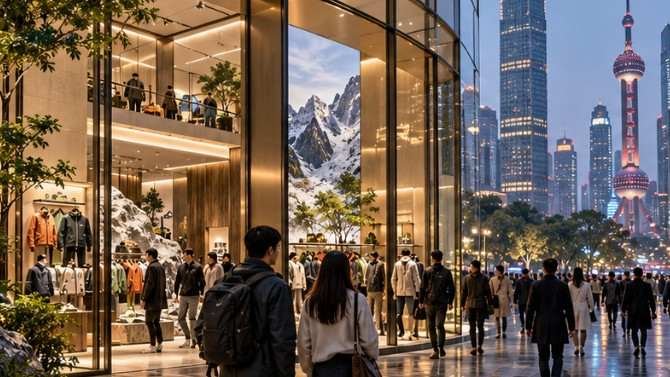
Another clue appears in Arc’teryx’s retail architecture.
Amer Sports has been expanding direct-to-consumer operations aggressively. Across the entire group, DTC revenue increased 41.5% in 2025 to approximately $3.21 billion, while wholesale revenue grew 15.1%.
Physical stores give a premium outdoor brand far more control over storytelling than a wholesale rack does.
A flagship can demonstrate fabric technology, alpine heritage, craftsmanship and product systems while creating the atmosphere associated with luxury retail.
That matters particularly when a $600 or $900 shell is being sold not only as weather protection but also as a desirable object.
A Four-Part Test for a Genuine China-First Strategy
So, is outdoor brand arcteryx pivoting to a china first strategy in the literal sense? I would use four tests before making that call.
1. Where is retail capital going?
China already has more Arc’teryx-owned stores than North America. Continued disproportionate investment would strengthen the China-first argument.
2. Where is product strategy originating?
A true China-first company would increasingly develop products, collections or experiences around Chinese consumers and then export successful concepts globally.
3. Where does growth depend most heavily?
Amer Sports’ Greater China revenue is growing far faster than its Americas revenue, although those figures include brands beyond Arc’teryx.
4. Is North America becoming secondary?
So far, the answer appears to be no. Amer continues to identify both North America and Greater China as foundational Arc’teryx markets. Using that test, “China-powered” is currently more accurate than “China-first.”
The U.S. Market Still Has Strategic Weight
It would be a mistake to interpret China’s rise as evidence that American consumers no longer matter. The Outdoor Industry Association reports that U.S. outdoor participation reached a record 183.2 million people in its 2026 report, equal to 59% of Americans age six and older. That creates an enormous home market for technical apparel.
The World Trade Organization also notes that global sports-goods imports nearly tripled between 1996 and 2022, while the Americas and Europe together account for almost three-quarters of imports.
Arc’teryx therefore has little reason to abandon Western demand. Instead, it can use different retail and marketing formulas in different markets.
China Also Carries Risks
Growth at this speed creates vulnerabilities. China’s economy is not producing effortless consumer growth. The World Bank said in July 2026 that Chinese consumers remained cautious as the property market continued adjusting.
The International Monetary Fund has similarly argued that domestic demand remains subdued and that China needs a stronger shift toward consumption-led economic growth. That matters for a company selling premium discretionary apparel.
There is also a brand-management risk. If Arc’teryx becomes too closely identified with urban luxury, it could dilute the technical credibility that originally made its products desirable.
The strongest strategy therefore keeps both identities intact: equipment serious enough for the mountain, but culturally desirable enough for Shanghai, New York or Los Angeles.
FAQs
1. Is Arc’teryx owned by a Chinese company?
Arc’teryx belongs to Amer Sports, whose ownership structure changed after a consortium led by China’s Anta Sports acquired Amer in 2019.
2. Is China more important to Arc’teryx than North America?
China is increasingly important, but Amer Sports still identifies both Greater China and North America as Arc’teryx’s core geographic markets.
3. Why is Arc’teryx so popular in China?
Technical credibility, premium pricing, distinctive retail experiences, fashion appeal and China’s expanding outdoor-sports culture have helped turn the brand into both performance gear and a status product.
4. Is outdoor brand Arc’teryx pivoting to a China first strategy permanently?
There is not enough evidence to call it permanently China-first. Current filings suggest a dual-engine strategy built primarily around Greater China and North America.
The Bigger Picture
My reading is that Arc’teryx has done something more sophisticated than simply moving its focus from Canada and the United States to China. It has discovered that the same technical credibility can create different forms of value in different markets.
In North America, outdoor participation remains enormous. In China, expanding outdoor culture, premium retail and fashion demand have given Arc’teryx an unusually powerful growth engine.
So the clearest answer to is outdoor brand arcteryx pivoting to a china first strategy is: almost, but not quite. China now shapes the brand’s global trajectory, yet North America remains too strategically important to call Arc’teryx a truly China-first company.