
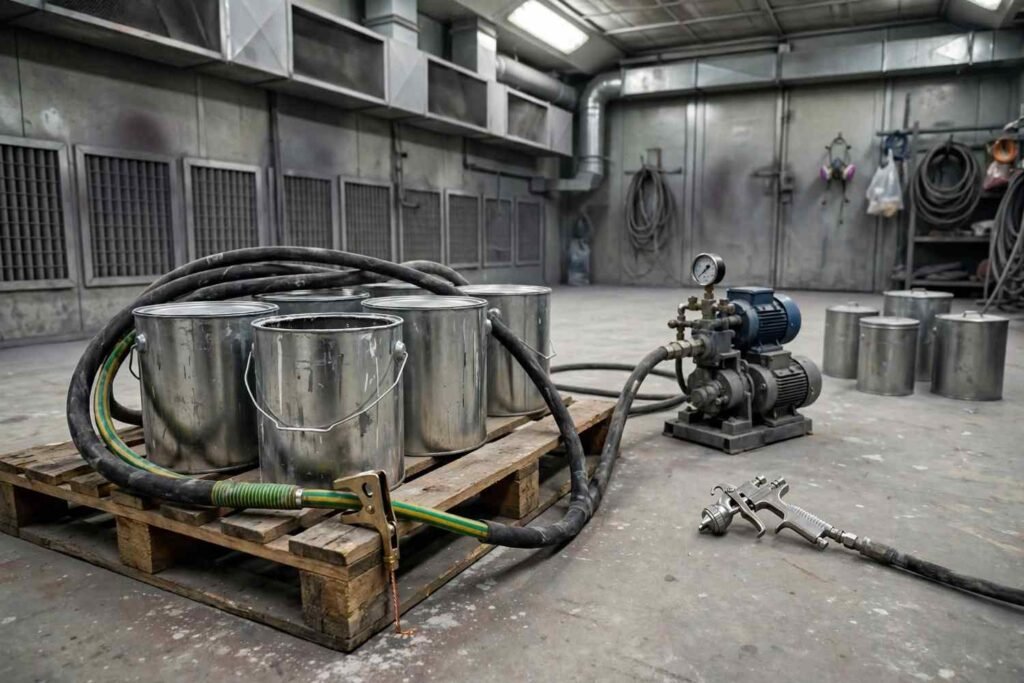
Inside an industrial finishing booth, a painter pulls the trigger on an airless spray gun. A fan of solvent-borne epoxy atomizes at 3,000 PSI, coating a structural steel beam in seconds. The booth ventilation hums, the finish looks clean, and the operation seems routine.
Yet within the fluid lines and atomized plume, an invisible hazard builds: high-voltage static electricity.
High-velocity spraying is an efficient method to coat manufactured goods, commercial equipment, and infrastructure. However, forcing viscous coatings and volatile solvents through narrow hoses and microscopic nozzles creates intense mechanical friction. This friction strips electrons, generating electrical charges that accumulate on equipment, paint containers, and operators.
In an atmosphere saturated with flammable solvent vapors, an unmanaged electrostatic charge is hazardous. When stored energy discharges across an air gap to a grounded surface, the resulting spark can ignite airborne vapors in a split second. Understanding airless paint sprayer static hazards and fluid charging physics is essential for protecting personnel, equipment, and facility operations.
1. Triboelectric Charging: How High-Velocity Fluid Generates Voltage
The quick answer: High-velocity fluid movement causes rapid electron transfer between paint molecules and hose linings, generating an electrical current known as streaming current.
Static electricity during spray operations does not require an external electrical hookup. It generates through the triboelectric effect—the physical transfer of electrons when two materials make contact and separate rapidly.
In airless systems, paint travels through high-pressure lines at speeds exceeding 100 feet per second:is generated
- Interfacial Shear: Fluid shearing against the inner hose wall strips electrons, driven by the chemical polarity of the resin and solvent.
- Orifice Atomization: Forcing fluid through a spray tip at 2,000 to 4,000 PSI shatters the stream into micro-droplets, releasing immense electrostatic charge into the plume.
- Streaming Current: This movement creates a measurable current. Without a path to earth, voltage builds rapidly, exceeding 10,000 to 25,000 volts within minutes.
2. Solvent Vapors and the Minimum Ignition Energy Threshold
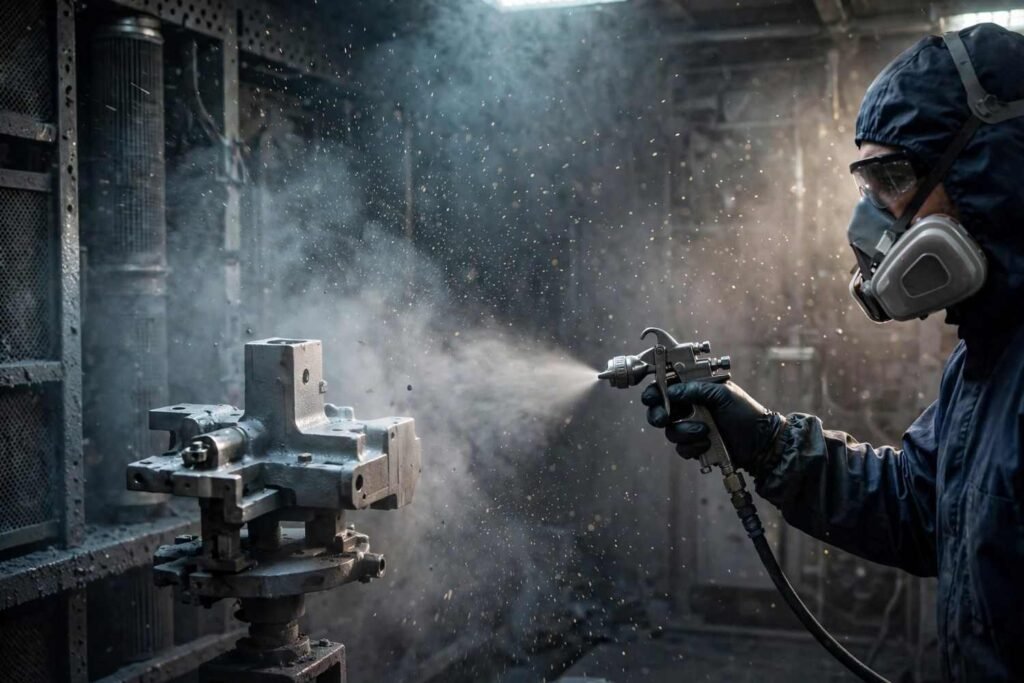
The quick answer: Flammable solvent vapors require minuscule energy levels (often below 0.25 millijoules) to ignite, meaning an imperceptible static spark can trigger an explosion.
The primary danger of static accumulation in spray finishing is the simultaneous presence of an optimal fuel-air mixture and an ignition source generated by the same tool.
Solvent-borne coatings rely on volatile organic compounds (VOCs) like xylene, toluene, and methyl ethyl ketone (MEK). As atomized paint leaves the nozzle, these solvents flash into vapor, creating a cloud operating within its Lower Explosive Limit (LEL).
Consider the low thresholds of solvent vapor minimum ignition energy:
- Human Sensation Limits: The shock felt touching a doorknob is typically 10 to 30 millijoules (mJ). Humans rarely feel static discharges below 1.0 mJ.
- Solvent Ignition Limits: MEK ignites at 0.53 mJ, toluene at 0.24 mJ, and xylene at only 0.20 mJ.
- The Ignition Risk: An electrostatic spark too small to feel or hear possesses enough thermal energy to ignite an unventilated solvent cloud instantly.
3. The Isolated Conductor Trap: Equipment as Capacitors
The quick answer: Any conductive metal object isolated from earth—such as a paint pail on a wooden pallet or an operator wearing rubber boots—acts as a capacitor, storing electrical voltage until it arcs to ground.
Electrostatic charges seek conductive pathways to earth. When equipment is electrically isolated, it behaves like a capacitor, storing energy across its metallic mass:
- The Spray Gun: If the fluid hose lacks electrical continuity, the metal gun body accumulates charge directly from the high-velocity fluid passing through the tip.
- Paint Supply Pails: Metal buckets resting on wooden pallets or cardboard have no contact with earth. As fluid circulates through bypass lines, the bucket charges rapidly.
- The Human Operator: A painter wearing rubber-soled boots is isolated from the floor. Holding an ungrounded gun transfers charge into the operator’s body. Touching a grounded booth wall can trigger an arc from their hand.
4. Fluid Hose Construction: Why Standard Lines Create Fire Hazards
The quick answer: Non-conductive hoses trap static charges inside the fluid line, while specialized conductive hoses incorporate continuous grounding wires to bleed charges harmlessly to the pump.
A primary cause of finishing room flash fires is using incorrect or damaged fluid hoses. Standard air lines or hydraulic hoses must never be used to transfer flammable finishing liquids under high pressure.
Safe high-velocity spraying relies on conductive fluid hose grounding:
- Internal Ground Wire Braiding: Certified airless paint hoses feature a continuous copper static wire or conductive core braided into the carcass, providing an unbroken electrical path from the gun back to the grounded pump.
- Broken Continuity Risks: Hoses crushed by forklifts, kinked, or spliced with plastic fittings lose their internal electrical bond, severing the static drain path even while paint still flows.
- Routine Continuity Testing: Facilities must test hoses regularly using a megohmmeter. Electrical resistance across the assembly must measure below specified safety limits (typically under 1 megohm).
5. Common Operational Mistakes That Break the Grounding Chain
The quick answer: Attaching ground clamps over dried paint overspray, using insulating gloves, and failing to bond metal collection pails during flush cycles are the leading procedural causes of static ignition.
Even when finishing facilities purchase certified conductive equipment, everyday operating shortcuts frequently break the grounding loop:
- Clamping Over Dried Paint: Attaching grounding cables to beams or drums coated in cured overspray fails because cured paint acts as a dielectric insulator, blocking electrical dissipation.
- Insulated Flush Operations: The highest flash-fire risk occurs during solvent flush cycles at shift end. Spraying pure solvent through an ungrounded gun into an unbonded waste pail creates rapid vapor generation and intense static build-up simultaneously.
- Non-Conductive PPE: Standard nitrile gloves and synthetic clothing insulate workers from conductive gun handles and generate additional friction charges as painters move.
6. Engineered Bonding and Grounding Protocols
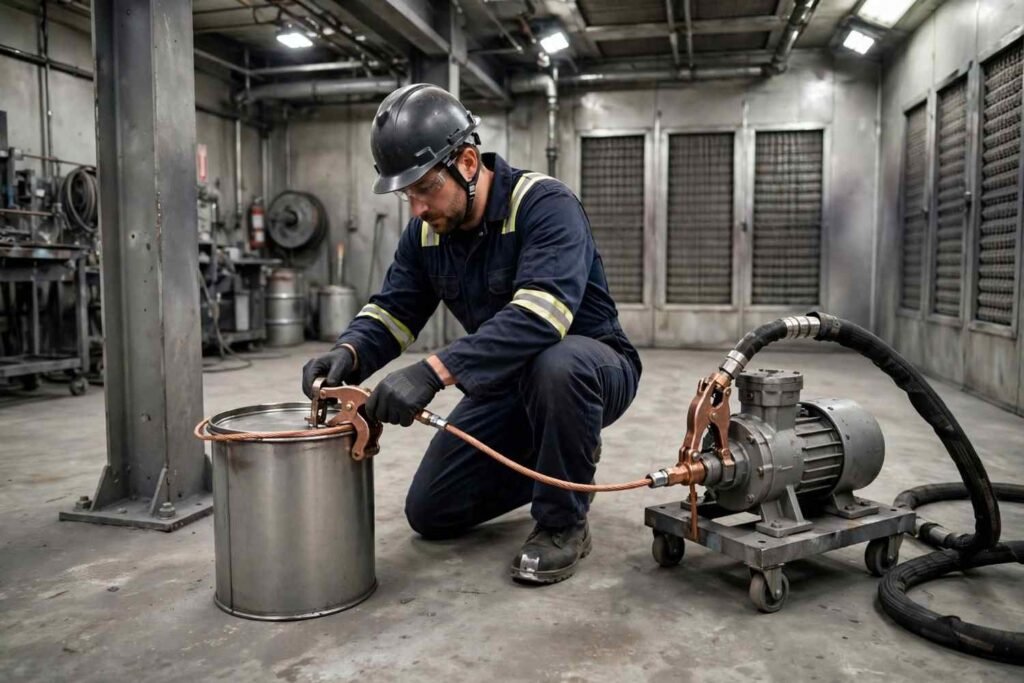
The quick answer: A safe spray operation requires a continuous, low-resistance electrical circuit linking the pump, paint drum, spray gun, workpiece, and structural earth ground.
Preventing static build-up requires providing a deliberate path of low electrical resistance directly to earth.
Implement an unbroken grounding circuit across every stage of the fluid path:
- Earth Ground Connection: Secure the main fluid pump directly to a certified building ground rod or structural steel column using heavy-gauge copper grounding wire.
- Mechanical Paint Penetration: Never rely on light alligator clips. Use a heavy-duty, spring-loaded grounding clamp for static discharge equipped with hardened stainless steel points that bite through layers of dried overspray, rust, and drum liners to make direct contact with bare metal.
- Dedicated Drum Bonding: Connect a flexible bonding cable with heavy-duty clamps between the fluid pump housing and the metal paint supply drum.
- Target Workpiece Grounding: The parts being painted must also be grounded. Ensure hanging conveyor hooks and racks are cleaned regularly to remove non-conductive paint buildup.
7. The Pre-Shift Static Safety Checklist
Before powering up high-pressure fluid pumps or atomizing flammable coatings, verify these mandatory safety checkpoints:
- [ ] Verify Pump Ground: Confirm the fluid pump’s copper grounding lead is securely fastened to a verified structural earth ground.
- [ ] Inspect Clamp Jaws: Ensure your grounding clamp points are sharp, clean, and biting directly into bare metal on the paint container.
- [ ] Check Hose Continuity: Inspect fluid hoses for physical damage, kinks, or improper splices; verify electrical continuity with a resistance meter.
- [ ] Bond Flush Containers: Connect a dedicated bonding wire between the gun tip or pump manifold and the metal waste receptacle during solvent cleaning.
- [ ] Enforce Conductive Footwear: Ensure operators wear static-dissipative (SD) safety boots and avoid insulated gloves when holding conductive gun casings.
- [ ] Confirm Ventilation Velocity: Verify booth airflow is operating at design specifications to maintain solvent concentrations well below 25% of the LEL.
High-velocity paint spraying is an industrial process that demands respect for the laws of physics. When pressurized fluids atomize at thousands of pounds per square inch, static electricity can become a serious safety hazard. Flammable solvent vapors provide the fuel, atomization can create a hazardous atmosphere, and an ungrounded piece of equipment may provide the spark.
Effective warehouse management also plays an important role in maintaining organized storage areas, implementing workplace safety procedures, and reducing operational risks in industrial environments. By using properly rated conductive hoses, inspecting grounding clamps, eliminating isolated conductors, and maintaining strict bonding and grounding practices, finishing operations can significantly reduce static ignition hazards, protecting both workers and facilities from potentially devastating flash fires.