

The gap between “I want that” and “Where do I buy it?” is one of the most expensive gaps in ecommerce. That matters more as shopping and content increasingly occupy the same screen. U.S. Census Bureau data shows ecommerce represented 17.1% of total U.S. retail sales in the second quarter of 2026. Meanwhile, Pew Research Center found that 62% of American TikTok users use the platform at least partly for product reviews or recommendations.
The most effective shoppable content strategy best practices are therefore not about inserting more “Buy Now” buttons. They are about connecting discovery, product understanding, trust, and purchase without making the content feel like a digital catalog.
What Makes Content Truly Shoppable?
Shoppable content allows someone to move directly from engaging with media to exploring or purchasing the featured product. That might happen through a product tag in a video, an interactive image, a creator post, a product carousel, a livestream, or an editorial page containing contextual buying links.
The distinction is important.
Traditional ecommerce asks shoppers to find the store first and investigate products afterward. Shoppable media reverses that sequence. A person may discover running shoes during a workout tutorial, cookware during a recipe video, or lipstick during a creator’s demonstration and immediately access the relevant product.
The content creates demand while the commerce layer captures it.
That is why brands should distinguish their overall content strategy from content marketing. Shoppable content works best when commerce is designed into the customer journey rather than added to every existing post.
1. Build Around Buying Questions, Not Product Features
A product-centered video might say a backpack has a 30-liter capacity, padded straps, and water-resistant fabric. A customer-centered video shows whether the backpack fits under an airline seat, how much clothing it holds, and what happens when it gets caught in rain.
The second version answers buying questions.
Before producing shoppable creative, identify the hesitation standing between the viewer and checkout. Common questions include:
“Will this fit me?”
“Does it work the way the brand claims?”
“What does it look like outside a studio?”
“Is the premium version worth the extra money?”
“What exactly comes in the package?”
Content that resolves uncertainty gives the product tag a reason to exist.
2. Shorten the Route From Interest to Product
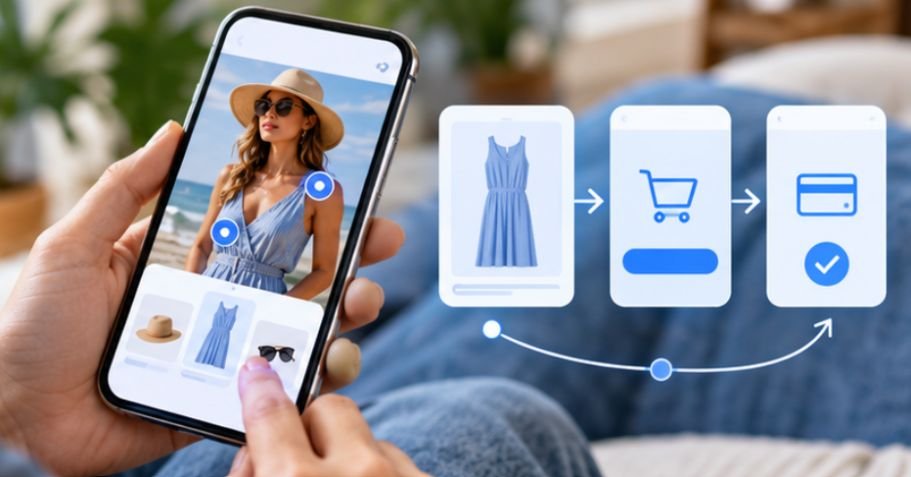
Every unnecessary transition creates another opportunity for the buyer to leave. Imagine someone watches a 30-second demonstration, becomes interested, visits the brand profile, searches through a link page, enters a store, searches the product name, selects the right variation, and finally reaches checkout. That is technically shoppable. It is not frictionless.
Whenever the platform supports it, connect the exact product shown in the content. Keep pricing, variants, product imagery, inventory, and availability synchronized with the ecommerce catalog.
This is particularly important during promotions. A viral video connected to an unavailable color or outdated price can turn momentum into frustration.
3. Treat Demonstration as the Primary Creative Format
Short-form shoppable video works because it can answer several questions faster than static product photography.
A useful 15- to 90-second video might demonstrate assembly, compare two sizes, show texture, test durability, reveal storage capacity, document an unboxing, or show a realistic before-and-after result.
The first seconds should establish the problem or outcome rather than introduce the company.
“Here is our new storage organizer” is weak.
“Here is what actually fits inside this organizer” creates a reason to keep watching.
The product should feel like the solution within the story rather than an interruption to it.
4. Make Product Tags Obvious Without Making Content Pushy
A strange tension exists in social commerce: the buying mechanism should be obvious, but the selling should not overwhelm the content.
Product tags should correspond precisely with what appears on screen. Captions can reinforce the use case and call to action, but viewers should not need to decode vague instructions such as “check the usual place.”
Strong calls to action are specific: view available sizes, compare colors, see current pricing, or shop the item demonstrated.
That clarity is also useful when improving content engagement metrics, because it gives marketers a clearer relationship between content interaction and commercial behavior.
5. Use Creators and Customers as Evidence, Not Decoration
Customer photos, demonstrations, reviews, and creator videos reduce the polished distance between a product and the person considering it.
There is real evidence behind that influence. Pew Research Center reported that three in ten U.S. adult social media users had purchased something after seeing an influencer or content creator post about it; among people who followed influencers, the figure was 53%. Authenticity, however, does not remove advertising obligations.
The Federal Trade Commission’s endorsement guidance says material relationships between a brand and an endorser must be clearly disclosed. The FTC also warns that disclosures should be difficult to miss rather than hidden after a “more” button or buried among hashtags.
For U.S. brands, compliance should therefore be built into creator briefs rather than handled after publication.
6. Turn Livestreams Into a Content Library

A one-hour shopping stream should not have a one-hour lifespan. Extract demonstrations, customer questions, comparison moments, objections, product close-ups, testimonials, and strong presenter explanations. Those clips can become short videos, product-page media, ads, email assets, and organic social posts.
This approach improves production economics. Instead of creating dozens of isolated pieces from scratch, one live event becomes raw material for weeks of commerce content.
The best clips are not always the moments with the most excitement. Frequently, they are the moments that answer a question buyers repeatedly ask.
7. Measure the Buying Journey, Not the Applause
Views can show distribution. Likes can indicate resonance. Neither proves commercial effectiveness. A practical measurement system follows customers deeper into the funnel.
| Stage | Useful Signal | What It Reveals |
| Discovery | Qualified views, retention | Whether content earns attention |
| Consideration | Product-detail views, tag clicks | Whether interest moves toward the product |
| Intent | Add-to-cart rate, checkout initiation | Whether shoppers seriously consider buying |
| Revenue | Conversion rate, AOV, attributed revenue | Whether content produces economic value |
For example, a creator video with 100,000 views and 300 product-page visits may be less commercially useful than a 20,000-view tutorial producing 1,500 product visits and 180 purchases.
Measure the entire path rather than rewarding the biggest number on the screen.
8. Apply a Five-Question Shoppable Content Test
Before publishing, evaluate every asset with five questions.
First, can someone understand the product’s value without reading additional marketing material?
Second, does the content answer a genuine buying question rather than simply displaying the item?
Third, can the viewer reach the correct product in one obvious action?
Fourth, are inventory, price, variations, disclosures, and product information accurate?
Fifth, can you track what happens after the interaction?
A “no” at any stage exposes friction that should be fixed before additional media spend amplifies the problem.
Don’t Forget Accessibility at Checkout
Reducing clicks does not help if the remaining experience is difficult to use.
The World Wide Web Consortium’s accessibility guidance covers issues including text alternatives, keyboard navigation, readable controls, and accessible forms. W3C specifically notes that an online buying process should be considered across the complete journey, including checkout.
That means captions for video, meaningful alternative text, clearly identifiable buttons, accessible product selectors, understandable error messages, and usable checkout forms belong in the commerce strategy.
Accessibility is not separate from conversion design. A purchase path customers cannot navigate is still purchase friction.
Where Shoppable Content Can Go Wrong
Not every piece of content should become transactional. Constant tagging can make an editorial feed feel like advertising inventory. Hard-selling products during unrelated entertainment can damage trust. Native checkout may also be inappropriate for products requiring extensive customization, consultation, regulated information, or lengthy consideration. Another mistake is optimizing entirely for immediate revenue.
Educational content can introduce the problem, creator content can provide validation, comparison content can support evaluation, and shoppable media can capture purchase intent. Different assets can play different roles without every impression producing an instant sale.
For a new ecommerce product, this approach works best when shoppable content is part of a coordinated launch plan rather than an isolated sales tactic. Learn how to align content marketing with ecommerce product launch to coordinate educational content, product demonstrations, creator campaigns, and launch messaging around each stage of the customer journey.
Frequently Asked Questions
1. What is a shoppable content strategy?
It connects useful digital content with direct paths to relevant products, allowing customers to move from discovery and evaluation toward purchase with fewer unnecessary steps.
2. Which content formats work best for social commerce?
Short demonstrations, tutorials, comparisons, creator videos, customer content, unboxings, livestreams, and interactive product imagery work well because they combine product context with immediate shopping access.
3. What are the most important shoppable content metrics?
Track product clicks, detail-page visits, add-to-cart rate, checkout initiation, conversion rate, average order value, attributed revenue, and return on ad spend alongside engagement metrics.
4. Do influencers need disclosures on shoppable posts?
Yes, when a material relationship exists. U.S. FTC guidance requires relevant brand relationships to be disclosed clearly and conspicuously so consumers can properly evaluate endorsements.
Final Take
The strongest shoppable experiences barely feel like separate shopping experiences at all. A customer sees a product solving a recognizable problem, gets enough evidence to decide whether it fits their needs, and can act without hunting for the next step.
That is the real lesson behind shoppable content strategy best practices: shorten the distance between curiosity and confidence, not merely the distance between a video and a checkout page.
Brands that connect useful storytelling, accurate catalogs, authentic proof, accessible buying experiences, and revenue-focused measurement can turn content from an audience-building expense into a measurable commerce channel.