
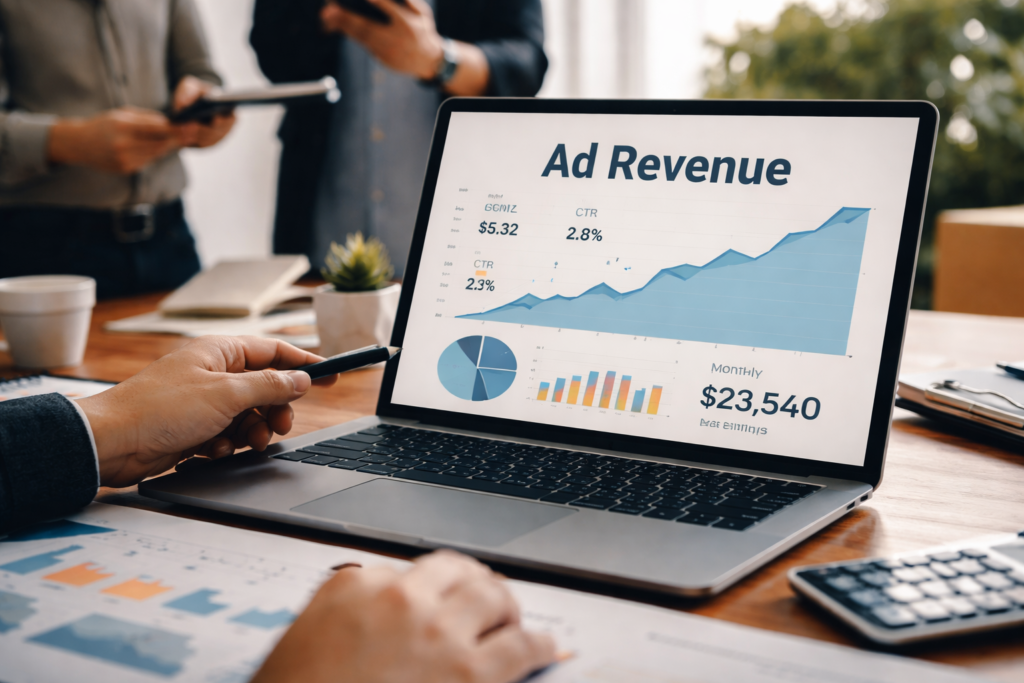
When I first started working with content-heavy websites, the instinct was simple: add more ads, make more money. That approach worked for about a month. Then bounce rates climbed, session durations dropped, and RPM started sliding in the wrong direction. What looked like a monetization win quietly turned into a long-term loss.
The shift happened when we stopped asking, “How many ads can we fit?” and started asking, “How can ads feel invisible but effective?” The most successful publishers today aren’t stuffing pages. They’re using ad revenue optimization techniques that protect performance, prioritize speed, and still drive serious yield increases.
Why Performance-First Monetization Wins

Search intent around ad revenue optimization techniques usually comes from publishers who want higher earnings without destroying engagement. That balance matters more than ever. A slow site or intrusive layout doesn’t just annoy visitors, it affects search rankings, conversion rates, and repeat visits.
Modern optimization now focuses on three pillars:
- High-yield formats that don’t disrupt flow
- Smart placement and density control
- Technical performance and data-driven delivery
When done right, publishers can increase revenue by 20–40% while maintaining session depth and improving ad viewability.
High-Yield, Low-Friction Ad Formats

The highest-performing ad formats in 2026 share one trait: they respect user intent.
Native advertising continues to outperform standard banners because it blends naturally with content. When an ad matches typography, layout, and tone, it feels integrated rather than forced. This reduces ad fatigue and often improves click-through rates without aggressive tactics.
Rewarded video ads have also proven extremely effective in gaming platforms and premium content environments. Giving users the choice to unlock something in exchange for watching an ad dramatically increases engagement. These formats can command CPMs several times higher than traditional display units because participation is voluntary.
Sticky anchor ads, horizontal placements at the bottom of the screen, offer strong viewability while remaining dismissible. Unlike pop-ups, they don’t block content. They stay visible but out of the way.
Interscroller and outstream video placements are another smart move. These ads appear between natural content breaks and only activate when in view. Because they don’t auto-play with sound or hijack attention, they maintain user-friendly ad strategies while maximizing viewable impressions.
The common thread across these formats is simple: they don’t interrupt the primary reason someone visited the page.
Strategic Placement and Ad Density Management

Many publishers try to maximize ad earnings by increasing ad units. But once density crosses a certain threshold, engagement drops sharply. Industry performance data consistently shows that exceeding five ad units on a standard content page often leads to declining performance.
Instead of adding units, smart publishers focus on placement psychology.
Above-the-fold space remains valuable, but overcrowding that zone can push readers away instantly. The primary content should still dominate the first screen. Ads should support, not overshadow.
Placing in-content ads at natural reading breaks significantly improves acceptance. When ads appear between logical paragraph transitions, they feel like pauses rather than interruptions.
Smart ad refresh is another powerful technique. Instead of refreshing ads on fixed timers, publishers trigger refreshes based on behavioral signals, scroll depth, active mouse movement, or minimum viewability thresholds. This approach improves session revenue techniques without causing banner blindness.
Balancing ad revenue and UX comes down to discipline. More ads do not automatically mean more revenue.
Technical Performance Optimization

Performance is where many monetization strategies quietly fail.
A slow site increases bounce rates and drives ad blocker adoption. If ads cause layout shifts or delay interaction, the damage compounds quickly.
Progressive and lazy loading are now essential. Ads should load only when users approach them, keeping initial load times fast and protecting Core Web Vitals. This also improves ad viewability because units load when they are actually visible.
Zero-layout shift- CLS control is non-negotiable. Reserving fixed dimensions for ad slots prevents content from jumping when ads render. Layout instability is one of the fastest ways to destroy trust.
Server-side header bidding has also gained traction. By moving auctions away from the browser, publishers reduce latency and improve responsiveness. This increases competition for inventory without negatively affecting front-end speed.
Optimizing Interaction to Next Paint (INP) is equally important. Suppose key buttons take longer than 200 milliseconds to respond because scripts are overloaded with ad requests, and conversion value drops. At that point, monetization is cannibalizing revenue instead of increasing it.
Data-Driven Personalization Without Intrusion

Privacy regulations have reshaped digital advertising. Third-party tracking is no longer the default advantage it once was. That shift has forced smarter approaches.
Contextual targeting now drives better performance than broad behavioral guesswork. An ad aligned with on-page content feels helpful instead of intrusive. Relevance has become a silent feature that improves both revenue and satisfaction.
First-party data infrastructure plays a major role. Session depth, repeat visits, and on-site interactions provide meaningful signals without compromising privacy standards. When used correctly, these insights improve ad placement optimization and relevance while maintaining compliance.
Continuous monitoring is the final piece. Publishers who track revenue alone miss half the picture. Tracking engagement metrics alongside monetization ensures that optimization efforts enhance the overall ecosystem instead of destabilizing it.
Frequently Asked Questions (FAQs)
1. What are the most effective ad revenue optimization techniques today?
The most effective ad revenue optimization techniques combine smart ad placement, performance optimization, contextual targeting, and behavioral ad triggers rather than simply increasing ad density.
2. Does increasing ad density always increase revenue?
No. Beyond a certain threshold, additional ads reduce engagement and session time, which can lower overall yield and long-term revenue performance.
3. How does header bidding improve monetization?
Header bidding increases competition among demand partners in real time, often improving CPMs without requiring additional ad units or intrusive formats.
4. Can optimizing for user experience really increase ad revenue?
Yes. Faster load times, stable layouts, and relevant ads improve engagement and viewability, which typically leads to stronger monetization performance over time.
Final Thoughts
The publishers, seeing sustainable growth, are not chasing short-term spikes. They’re engineering systems where monetization and experience reinforce each other. Ad revenue optimization techniques today revolve around precision, restraint, and performance awareness. When ads feel native to the journey, load quickly, and respect user intent, revenue scales naturally. The key is thinking long-term rather than squeezing every pageview for immediate yield.
Optimize for experience first. Revenue follows.