
A shopper considering a $4,000 sectional sofa rarely needs another promotional discount. They need confidence that the furniture fits their space, matches their preferences, and justifies the investment.
That distinction explains why interactive calculators vs product quizzes for high AOV stores has become an important ecommerce conversion strategy. Both tools simplify expensive purchases, but they remove different obstacles.
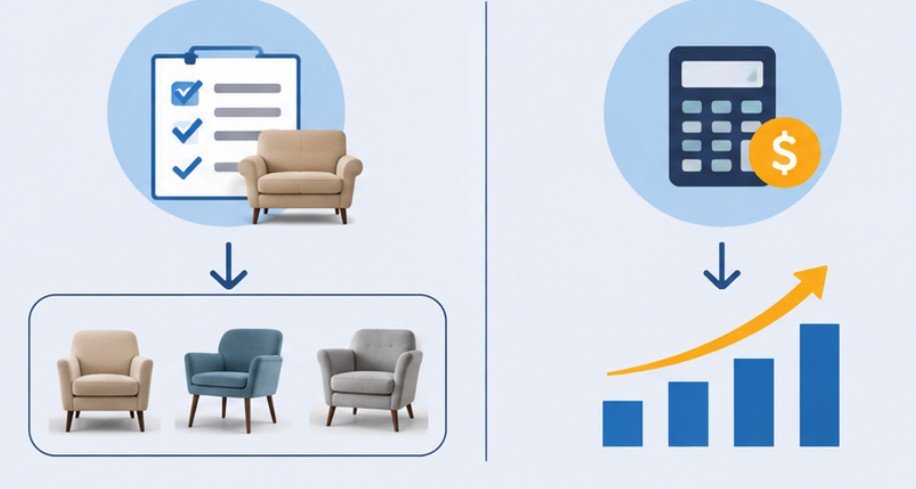
Product quizzes help customers discover suitable products, while interactive calculators clarify costs, quantities, and potential financial benefits.
Choosing the right approach can improve product discovery, support larger purchases, and reduce hesitation before checkout.
When Product Quizzes Create More Valuable Orders
Product recommendation quizzes work particularly well when retailers offer extensive catalogs, customizable products, or combinations of complementary items.
Turning Customer Preferences Into Product Matches
Consider a luxury furniture retailer offering hundreds of seating configurations.
Instead of requiring visitors to compare every sectional, a short quiz could ask about living-room dimensions, preferred materials, household activity, and decorating preferences.
The results might recommend three suitable configurations with matching tables or accessories.
This experience reduces browsing effort while introducing relevant products customers might otherwise overlook.
Increasing Basket Value Through Personalized Bundles
Quizzes can also support higher average order values by recommending coordinated purchases.
For example, a premium outdoor retailer might suggest a complete camping setup rather than a single tent.
However, additional recommendations should reflect genuine customer requirements. Irrelevant upsells can weaken confidence in the recommendation engine.
The strongest quizzes explain why individual products match the information customers provided.
Retailers can further strengthen these personalized recommendations by incorporating authentic customer-created videos and product demonstrations that show how recommended items perform in real-world situations; explore these strategies for turning UGC into converting e-commerce content.
Using Customer Information Responsibly
Quiz responses reveal valuable first-party information, including preferences, budgets, and purchasing intentions.
Retailers can use this information to improve product recommendations and, where appropriate consent exists, personalize subsequent marketing.
Avoid collecting unnecessary sensitive information or requiring an email address before delivering basic recommendations.
Why Interactive Calculators Work for Expensive Products

Calculators become especially useful when customers need numerical evidence to evaluate a purchase.
They replace vague pricing claims with estimates based on individual circumstances.
Making Complex Costs Easier to Understand
Imagine a homeowner purchasing custom patio materials.
A calculator could request dimensions, material preferences, and installation requirements before producing an estimated project cost.
Suppose a patio measures 20 feet by 15 feet. Its area equals 300 square feet.
If hypothetical material costs average $12 per square foot, the estimated material expense is $3,600 before labor, delivery, waste, and taxes.
The calculation makes project requirements understandable without pretending to provide a final contractor quotation.
Demonstrating Potential Long-Term Value
Calculators also help explain purchases involving operating expenses or savings.
The ENERGY STAR savings calculator demonstrates this approach by using household and equipment information to estimate potential heating and cooling savings.
A premium appliance retailer could apply similar principles when comparing operating costs across product models. However, estimated savings must reflect reasonable assumptions.
The Federal Trade Commission’s advertising guidance explains that businesses need evidence supporting objective advertising claims.
Therefore, retailers should clearly distinguish illustrative calculations from verified performance guarantees.
The Hybrid Approach: Combining Discovery With Financial Clarity
For complicated purchases, combining a quiz with a calculator can deliver a more complete customer experience.
A custom window retailer, for instance, might begin by asking about architectural preferences, privacy requirements, and preferred materials.
After recommending suitable window styles, the experience could request measurements and installation details.
The calculator would then generate an estimated price range based on the selected configuration.
This sequence addresses two distinct questions: Which product should I buy, and what will it cost?
Build a Connected Customer Journey
A practical hybrid experience should follow four stages:
- Discover: Ask customers about their needs and preferences.
- Recommend: Present suitable products with clear explanations.
- Calculate: Estimate the relevant price, quantity, or financial outcome.
- Convert: Offer checkout, a saved configuration, or a consultation.
Crucially, previously entered information should carry forward automatically.
Forcing shoppers to repeat measurements or preferences creates avoidable frustration.
How to Choose the Right Tool for Your Store

Before investing in either technology, identify the biggest obstacle preventing customers from purchasing.
For retailers selling to business buyers, this evaluation should also consider longer purchasing cycles, multiple decision-makers, and the need for educational content that supports complex buying decisions; explore this B2B ecommerce content marketing strategy for additional insights.
Step 1: Examine Customer Questions
Review customer-support conversations, abandoned-cart feedback, and sales consultations.
These customer interactions can also reveal unanswered questions and overlooked search topics that competitors may not be addressing; explore this approach to finding content ideas your competitors missed.
If shoppers frequently ask which product suits their requirements, prioritize a recommendation quiz.
If they primarily ask about dimensions, installation expenses, or operating costs, a calculator may provide greater value.
Step 2: Evaluate Product Complexity
Stores offering numerous aesthetic choices often benefit from guided discovery.
Businesses selling products determined by dimensions, quantities, or financial specifications may need calculation tools.
Custom products involving both categories are natural candidates for hybrid experiences.
Step 3: Test Against an Existing Shopping Journey
Compare the interactive experience with standard product browsing through a controlled experiment.
Monitor quiz or calculator completion rates, conversion rates, average order value, revenue per visitor, and product returns.
For example, if a store generates $80,000 from 40 orders, its AOV is $2,000.
If an experiment produces $96,000 from 40 orders, AOV increases to $2,400, representing a 20% improvement.
However, higher AOV alone does not establish success. Evaluate total revenue, profitability, and customer satisfaction.
Common Mistakes That Reduce Interactive Tool Performance
Even sophisticated tools can disappoint when implementation ignores customer expectations.
Overly lengthy quizzes create unnecessary work, while calculators requiring technical information customers do not possess become difficult to complete.
Recommendation systems can also fail when they prioritize expensive inventory over suitability.
Accessibility deserves attention, too. The World Wide Web Consortium’s accessibility guidance recommends clearly labeled form controls that people can understand and operate using assistive technologies.
For financing calculations, transparency is equally important. The Consumer Financial Protection Bureau’s payment guidance demonstrates how loan amounts, interest rates, and repayment terms influence monthly payments.
Retailers should communicate relevant assumptions, additional fees, and financing conditions rather than presenting incomplete estimates as guaranteed costs.
Finally, not every store requires an interactive experience. A small catalog with straightforward specifications may perform better with excellent filtering, comparison pages, and transparent pricing.
Frequently Asked Questions
1. Are product quizzes better than calculators for increasing AOV?
Product quizzes may increase AOV through relevant bundles and cross-selling. Calculators can support larger purchases by explaining costs and upgrades. Results depend on customer needs and implementation.
2. Should luxury ecommerce stores use both tools?
Stores selling complex, customizable products may benefit from combining quizzes and calculators. Simpler catalogs often need only one tool or improved product filtering.
3. How many questions should a product recommendation quiz include?
Start with four to six meaningful questions. Add questions only when their answers materially improve recommendations, and test completion rates to identify unnecessary steps.
4. What metrics determine whether an interactive shopping tool works?
Track completion rates, conversion rates, average order value, revenue per visitor, and returns. Compare results against a suitable control group before attributing improvements to the tool.
Solve the Buying Problem Before Selling the Product
Expensive purchases rarely fail because shoppers lack choices. More often, customers lack sufficient clarity to make a confident decision.
The debate around interactive calculators vs product quizzes for high AOV stores ultimately depends on identifying that missing information.
When uncertainty involves product compatibility, preferences, or bundled solutions, quizzes offer practical guidance. When the obstacle involves price, measurements, or financial value, calculators provide a clearer path forward.
For particularly complicated purchases, combining both experiences may be worthwhile.
The strongest ecommerce strategy is not necessarily the most interactive. It is the one that makes an expensive decision feel understandable, transparent, and worth completing.